The closure system on a supplement bottle determines tamper evidence, child resistance, moisture sealing, and the daily user experience. It is also the specification that brands most often under-specify, leading to expensive problems after production begins.
FDA approval ensures that the packaging materials meet rigorous safety standards set by the U.S. Food and Drug Administration, critical for protecting consumers from potential health risks. For supplement products specifically, the Poison Prevention Packaging Act (PPPA) requirements for child-resistant packaging are a critical compliance consideration.
While dietary supplements are not automatically required to use child-resistant packaging under PPPA, iron-containing supplements are specifically regulated: the FDA has a Final Rule requiring unit-dose packaging or child-resistant packaging for iron-containing dietary supplements and drugs. Beyond the iron-specific requirement, many supplement brands choose CRC as a risk management decision — and many retailers require it as a condition of distribution.
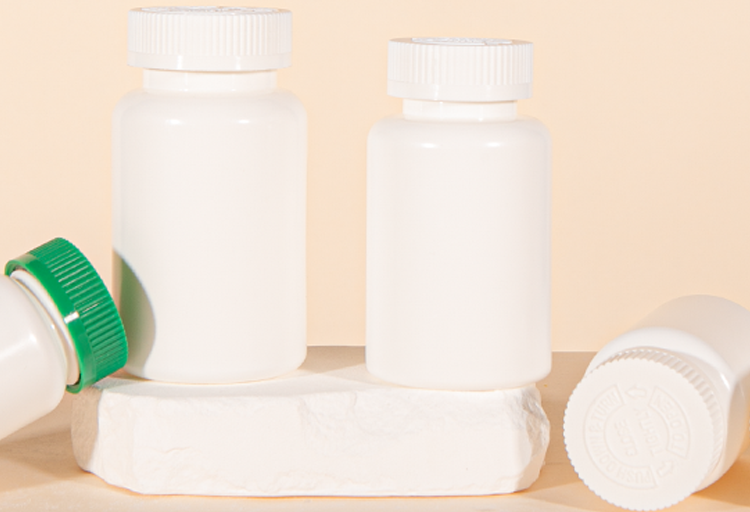
The standard CRC mechanism for supplement bottles is a press-and-turn cap: the consumer presses down on the cap while simultaneously turning it to disengage the locking tabs. This requires a level of hand strength and coordination that is beyond most young children. For HDPE bottles, the slight material flexibility is what allows the press-down motion to work correctly — which is one reason HDPE is so dominant in the pharmaceutical and supplement closure category.
At Sunripack, we supply CRC closures in both 38mm and 45mm sizes matched to our HDPE bottle range, available in child-resistant or non-child-resistant configurations. We confirm the CR certification status of each closure upon request for US market compliance documentation.
An induction liner is a foil-based liner disc that is applied inside the cap before the bottle is sealed. At the filling line, the capped bottle passes under an induction sealing unit that uses electromagnetic energy to bond the foil liner to the bottle rim, creating a hermetic seal. When the consumer opens the bottle for the first time, they see a foil disc that must be peeled or punctured — a clear tamper-evident indicator and a meaningful moisture barrier.
Induction lining is not optional for most supplement products sold through retail. Retailers including major US natural food chains typically require induction-sealed packaging as a condition of listing. It is also a consumer expectation: a supplement bottle without an induction liner signals that the product may have been opened.
Liner type selection matters. Foam-backed liners are appropriate for most capsule, tablet, and gummy applications — the foam layer conforms to minor neck surface imperfections and accommodates the non-level top surface of gummy-filled containers. Straight foil liners provide a more hermetic seal for powder and liquid supplements where absolute moisture exclusion is the priority. Confirm liner type with your filling partner before finalizing your closure specification.
Desiccant is one of the lowest-cost, highest-impact investments in supplement packaging quality. The three delivery formats most commonly used are:
Loose desiccant packets inserted into the bottle after filling — the most familiar format, using silica gel in a paper or Tyvek sachet. Inexpensive and effective but requires an insertion step on the filling line.
Canister desiccants — a rigid plastic or aluminum canister containing desiccant, which drops into the bottle like a third-party component. More expensive than packets but integrates cleanly and is preferred for premium product presentations where a loose packet inside the bottle looks low-quality.
Desiccant-infused closures — cap closures with desiccant incorporated into the cap lining material itself, eliminating the in-bottle desiccant entirely. This is the cleanest consumer experience and is increasingly used by premium supplement brands that want a bottle interior free of any added components.
Dietary supplements fall under the Dietary Supplement Health and Education Act (DSHEA), which treats supplements as a category of food. Supplements do not require FDA preapproval before going to market — but they do require compliant labeling and proper Good Manufacturing Practices (GMPs).
This distinction is important for brand owners to understand: the FDA regulates how supplement products are manufactured and how they are labeled, but it does not pre-review and approve supplement formulas before they go to market. The compliance burden falls entirely on the manufacturer and brand owner to ensure that their product and packaging meet the applicable standards.
FDA approved packaging ensures that the packaging materials meet rigorous safety standards. This is critical for protecting consumers from potential health risks associated with harmful substances that may leach into the product from non-compliant packaging.
For your bottle specifically, FDA compliance means using food-contact-grade resin — material manufactured to the standards specified in FDA 21 CFR 177 (which covers polymer resins for food contact applications). Both HDPE and PET have long-established food-contact approvals under these regulations, and both are BPA-free in their standard supplement-grade formulations.
When sourcing supplement bottles from a Chinese OEM manufacturer, you should request documentation confirming that the resin used in your bottles meets FDA 21 CFR 177 requirements. At Sunripack, we provide SGS food-contact test certificates for our HDPE and PET supplement bottle production, confirming that migration levels of regulated substances are within FDA acceptable limits. This documentation is often required by US supplement contract manufacturers and co-packers before they will fill a product into packaging from a new supplier.
21 CFR 111 covers Current Good Manufacturing Practices for packaging and labeling operations for dietary supplements. For a Chinese packaging manufacturer supplying the US supplement market, GMP compliance means that the factory’s quality systems, documentation practices, and production controls meet a defined standard for consistency and traceability.
At Sunripack, our production documentation includes batch records for resin, colorant, and production date that can be provided to clients needing traceability documentation for their GMP compliance files. We also facilitate third-party factory audits by GMP certification bodies for supplement clients who require audited supplier status as part of their regulatory compliance program.
FDA rules specify several mandatory components that must appear on every supplement package. The front of the package (Principal Display Panel) must clearly identify the product as a “Dietary Supplement.” Additional required elements include the Supplement Facts panel (with serving size, servings per container, and a complete list of dietary ingredients and amounts per serving), net quantity statement, manufacturer or distributor information, and warning statements where applicable.
The Supplement Facts panel introduced updated formatting requirements in 2016 — including new Daily Value references, mandatory declaration of added sugars, and updated serving size requirements for certain formats. As of 2025, small manufacturers who received compliance extensions must be operating under the updated format.
The practical packaging implication: your bottle’s label panel must be large enough to accommodate all required regulatory text at legally legible font sizes. For bottles below 100ml in volume, the entire bottle surface may be needed for compliance text, leaving minimal space for brand design elements. Confirm your label panel dimensions with your bottle manufacturer before commissioning label design — discovering a sizing conflict after label artwork is complete is an expensive delay.
Sizes and Formats: Matching the Container to the Purchase Occasion
The size of your supplement bottle should be determined by three factors: the serving count your customer expects, the price point your formula can support, and the retail channel where the product will be sold.
30-Count vs 60-Count vs 90-Count vs 180-Count
30-count is an introductory or sample-sized format — one month’s supply for once-daily products. It is appropriate for new product launches, premium-priced formulas where the entry price point of a 30-count is more accessible, or products targeted at trial-and-discovery rather than habitual use.
60-count is the standard retail size for twice-daily supplement products and the second-most-common format overall. It provides approximately one month’s supply for a two-capsule serving, which aligns with the purchase frequency most supplement consumers accept.
90-count is a one-month supply for three-capsule-per-day servings, or a 45-day supply for twice-daily use. This format is common in therapeutic or clinical supplement lines where serving sizes are higher, and in channels where value sizing is a purchase driver.
180-count and above is the value-pack format — two to three months’ supply in a single purchase. This format is dominant in club retail (Costco, Sam’s Club), mass market, and direct-to-consumer subscription programs where average order value is a key business metric. Larger bottles require structural rigidity at their scale — HDPE is the appropriate material for all containers above approximately 300ml volume due to its superior structural performance under storage and handling conditions.
Powder supplements are typically sized by net weight rather than count. The dominant sizes in retail are 300g, 500g, 1lb (454g), and 2lb (908g), with 5lb sizes in the professional/clinical channel. Container volume must accommodate not just the powder weight but also the headspace needed for the scoop and for the desiccant or oxygen absorber that protects the formula.
A common brand owner mistake is specifying a container that is technically large enough for the powder weight but leaves insufficient headspace after scooping — resulting in spilled powder every time the consumer opens the lid. Work with your contract manufacturer to confirm the actual fill volume (powder weight ÷ bulk density of your specific formula) and specify a container with at least 25% headspace above the fill line.
PET and HDPE containers are widely recyclable. The challenge is that labels, inks, and adhesives can contaminate the recycling process. Brands that utilize preferred components from the APR Design Guide for Plastics Recyclability ensure their packaging can recycle into high-quality post-consumer recycled content.
For supplement brands with sustainability commitments, several options are commercially available today:
PCR HDPE — post-consumer recycled HDPE is available for supplement bottle production, with recycled content levels from 25% to 50% being the most common commercial specifications. At these levels, PCR HDPE performs equivalently to virgin HDPE for supplement applications. Recycled HDPE is reviewed by the FDA on a case-by-case basis, as it can sometimes become unsafe in the recycling process — which means brands using PCR HDPE for food-contact supplement packaging should ensure their supplier provides FDA non-objection documentation for the specific PCR content and resin used.
PCR PET — recycled PET (rPET) has the most mature supply chain of any recycled plastic, and food-contact-grade rPET is commercially available at scale. For clear PET supplement bottles, PCR content can typically be incorporated at 25–100% without affecting the clarity or performance characteristics that make PET valuable for gummy and visual supplement formats.
Label compatibility for recyclability — the APR recommends using wash-off label adhesives (rather than permanent adhesives) and clear or translucent film labels on HDPE and PET bottles to improve recycling outcomes. When the label can be separated from the bottle in the recycling wash process, the bottle material is cleaner and produces higher-quality recycled resin.
At Sunripack, we supply PCR HDPE and PCR PET supplement bottles with third-party certified recycled content documentation, available to brands that need to substantiate sustainability claims in their marketing or meet retailer sustainability requirements.