The supplement industry is one of the most competitive retail categories on the planet. Walk into any health food store or scroll through Amazon’s vitamin section, and you’ll see hundreds of brands selling essentially the same formulas — the same vitamin D3, the same fish oil, the same ashwagandha — at dramatically different price points and sell-through rates. The single most consistent differentiator between the brands that command premium shelf space and the brands that get lost in the bottom of the aisle? Packaging.
Not just the label. The bottle itself — its material, its opacity, its closure system, its size, and its compliance credentials — signals everything your customer needs to know about whether your product can be trusted before they’ve read a single word of your copy.
This guide covers what supplement and nutraceutical brands need to know about packaging material selection, format decisions, closure specifications, FDA compliance, and sustainable options — written from the perspective of a factory that manufactures these bottles every day and has seen every mistake a brand owner can make before committing to a production run.
Most consumer packaged goods live in a forgiving packaging environment. If a bottle of dish soap is slightly under-spec for moisture resistance, the soap still works. If a cosmetic serum bottle has a minor aesthetic defect, the product still performs.
Supplement packaging operates under a different standard. Vitamins, minerals, probiotics, herbal extracts, and functional ingredients are biologically active compounds whose potency is directly affected by their environment. Expose vitamin C to moisture and it degrades within weeks. Leave fish oil softgels in a clear bottle on a sunlit shelf and the omega fatty acids oxidize, producing the rancid smell every consumer has encountered in a low-quality product. Allow a powder supplement to absorb ambient humidity and it clumps into a solid block that no consumer can use.
High-quality PET and HDPE materials, combined with reliable closures, ensure your supplements reach consumers exactly as formulated. That’s not marketing language — it’s a technical requirement. The right bottle is not a nice-to-have for supplement brands. It is the difference between a product that delivers what the label promises and one that doesn’t.
Three environmental threats drive almost every supplement packaging failure: moisture, oxygen, and light. Every material decision, every closure choice, and every format decision in this guide is ultimately about neutralizing one or more of these three threats.
PET and HDPE are the most common plastics for packaging vitamins, dietary supplements, functional foods and beverages. Understanding what makes each material the right choice for specific supplement formats is the foundation of every other packaging decision.
HDPE is the most widely used material for supplement bottles globally, and for good reason. Walk into any pharmacy, health food retailer, or mass-market store in the US, UK, Australia, or Europe, and the vast majority of vitamin and supplement bottles on the shelf are HDPE. This is not an accident of convention — it reflects real performance advantages that matter specifically for solid supplement formats.
Moisture and oxygen barrier. HDPE’s dense, semi-crystalline molecular structure creates a natural barrier against moisture vapor transmission — the rate at which ambient humidity passes through the bottle wall and reaches the product. For hygroscopic supplements (those that absorb moisture from the air) — including most powder supplements, effervescent tablets, probiotics, and many encapsulated products — a high-barrier container is essential to maintaining product texture, potency, and shelf life. HDPE delivers this barrier reliably at every point in the supply chain, including the warm, humid shipping container conditions common in international logistics.
Light protection. HDPE is the most common plastic used for solid pharmaceutical products and is known for its moisture resistance and structural strength. Standard white or opaque HDPE provides complete UV and visible light blocking — no additional coating or colorant is required. For light-sensitive supplements including vitamin B2 (riboflavin), vitamin D, omega fatty acids, and many botanical extracts, this passive light protection is critical to maintaining potency through the product’s shelf life. A clear bottle on a retail shelf under fluorescent lighting is an active threat to some formulas; opaque HDPE neutralizes that threat entirely.
Structural rigidity. HDPE bottles maintain their shape under the stacking and compression loads of pallet storage, wholesale distribution, and retail display. For large-format supplement containers — 500 count, 300g powder tubs — the structural integrity of HDPE prevents deformation that would make the bottle look damaged or low-quality at retail.
Child-resistant closure compatibility. HDPE’s slight material flexibility is precisely what allows child-resistant (CR) closures to function correctly. The press-and-turn mechanism in a standard CRC requires the bottle neck to flex slightly as the cap is pressed down before turning — a rigidity level that HDPE delivers naturally, and that more brittle plastics cannot replicate reliably.
Where HDPE leads: capsules, softgels, tablets, powders, probiotics, mineral supplements, herbal extracts, and any solid supplement format where moisture control and light protection are the primary packaging requirements.
PET delivers glass-like transparency that showcases the color, size, and texture of the product inside — vitamins, gummies, softgels — giving consumers an immediate visual cue of quality. In a retail environment where a product has seconds to capture attention, this matters enormously.
The growth of the gummy supplement category — now one of the fastest-growing segments in the entire supplement market — is inseparable from PET packaging. Gummies are a product where the visual appeal of the product is the primary purchase driver. Their color, texture, shape, and size communicate quality before a consumer ever reads the label. A gummy supplement in an opaque HDPE bottle is asking consumers to trust what they cannot see; the same product in a clear PET bottle sells itself.
Beyond gummies, PET is also the preferred choice for colorful tablet vitamins, specialty softgels where the gold or amber color signals quality (fish oil, evening primrose, vitamin E), and any supplement brand that has invested significantly in product aesthetics and wants the packaging to showcase that investment.
PET’s printability advantage is also worth noting for brands moving toward direct-to-consumer e-commerce. Both materials are BPA-free, food-grade, and compliant with FDA and USP standards for supplement and pharmaceutical packaging. But PET’s superior surface for high-resolution printing — silk screen, hot foil, shrink sleeve — gives e-commerce brands more options for creating packaging that photographs well and stands out in a digital product listing, where the bottle image is often the primary conversion factor.
Where PET leads: gummies, colorful chewable vitamins, specialty softgels, liquid supplements, functional shots, and any product format where visual appeal is a primary purchase driver.
| Property | HDPE | PET |
|---|---|---|
| Moisture vapor barrier | Excellent | Good |
| Light/UV protection | Excellent (opaque) | None (clear); good (amber) |
| Impact resistance | Superior | Strong |
| Transparency | Opaque / translucent | Crystal clear |
| Child-resistant closure | Ideal — designed for CRC | Compatible but less flexible |
| Surface decoration | Good (label-based) | Excellent (print + label) |
| Typical supplement use | Capsules, tablets, powder, probiotics | Gummies, softgels, liquid, chewables |
| Unit cost comparison | Slightly lower at volume | Moderate |
| Recyclability | ♻ #2 — widely recyclable | ♻ #1 — most widely recycled |
The choice between HDPE and PET is rarely a close call once you know your product format and your primary retail channel. When in doubt, ask: does my consumer need to see the product to want to buy it? If yes, PET. If no, HDPE.
Supplement products span an enormous range of physical forms, and the packaging requirements vary significantly by format. Here is a practical reference for the most common supplement types and the packaging specifications that protect them.
Capsules (hard-shell gelatin or vegetarian HPMC) and tablets are the most common supplement format globally. Both are hygroscopic — they absorb moisture from the air and degrade in texture, potency, and appearance when exposed to humidity. Gelatin capsules are especially vulnerable: at elevated humidity they soften, stick together, and ultimately lose the integrity of the shell.
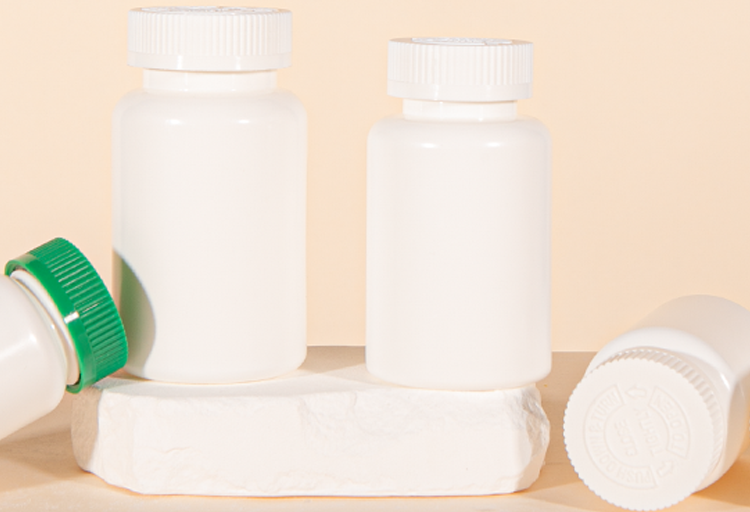
For capsules and tablets, white or natural HDPE is the default choice at every market tier. A 38mm or 45mm wide-mouth opening allows filling equipment to flow product efficiently and allows consumers to retrieve individual units without difficulty. The bottle should be paired with an induction heat seal liner — a foil liner that is heat-bonded to the bottle neck after filling, providing a hermetic moisture seal and a tamper-evident indicator — before the closure is applied.
Desiccant is nearly always required. Silica gel packets or desiccant canisters are included inside the bottle to absorb any residual moisture present after filling and to protect against moisture ingress during the product’s shelf life. For oxygen-sensitive capsule formulas — probiotics and certain antioxidant compounds in particular — an oxygen absorber may also be specified alongside the desiccant.
Softgels are gelatin capsules filled with an oil-based formula — fish oil, vitamin D3 in oil suspension, evening primrose, CLA, and similar products. The oil fill makes softgels particularly sensitive to two things: oxidation of the oil (especially omega-3 products, which go rancid when exposed to oxygen) and UV light degradation of the fill formula.
For standard fish oil and omega products, amber HDPE or dark amber PET bottles are the specification of choice. The amber color provides UV blocking while the material’s oxygen and moisture barrier protects the oil fill. For vitamin E, vitamin D3 in oil, and herbal oil extracts, the same specification applies.
The one exception in the softgel category is premium fish oil brands that use a clear PET bottle specifically to let consumers see the golden color of the oil fill — a visual quality signal in premium Omega-3 products. When this approach is used, the product typically comes in secondary packaging (a printed carton) that protects the bottle from light exposure during retail display. This is a valid brand strategy, but it requires the secondary packaging to actually be used consistently throughout the distribution chain.
The gummy supplement format requires a different packaging approach than solid forms. Gummies are a semi-moist product — they contain water activity and are sensitive to temperature as well as humidity. At elevated temperature, gummies can soften and fuse together; in high humidity, the sugar coating absorbs moisture and becomes sticky.
Wide-mouth PET bottles in clear or lightly tinted configurations are the standard for retail gummies. The wide mouth (typically 53mm or 63mm) allows gummies to flow in and out without crushing, and the clear bottle allows the color and shape of the gummies to be visible at retail. A foam induction liner (rather than a full foil liner) is often specified for gummies because foam liners conform to the irregular top surface of loosely filled gummy containers and provide a better seal than flat foil on a non-level product surface.
Do not pack gummies in opaque HDPE unless there is a specific reason for it. The gummy category’s purchase decision is visual — if consumers cannot see the product, you lose the primary selling advantage of the format.
Powder supplements — protein powders, greens blends, pre-workout formulas, collagen peptides, and meal replacements — require large-format, wide-mouth containers with excellent moisture barriers. Powder formulas are highly hygroscopic and will clump, cake, and discolor when exposed to moisture. A clumped powder product is one of the most common consumer complaints in the supplement category and one of the most preventable with correct packaging specification.
Wide-mouth HDPE containers in sizes from 300g to 2kg are the industry standard. The wide mouth allows scooping. The HDPE barrier prevents moisture ingress in the warehouse, in transit, and in the consumer’s kitchen or gym bag. A foil induction liner is essential for powders — it creates the hermetic seal that maintains the moisture barrier from the point of filling to the moment of first use.
Desiccant is mandatory for virtually every powder supplement. Include a silica gel packet sized appropriately for the container volume (1g desiccant per approximately 50ml of headspace is a general starting reference; consult your desiccant supplier for product-specific recommendations).
Liquid supplements — herbal tinctures, liquid vitamins, functional shots, and adaptogen drops — require packaging specifications closest to the pharmaceutical end of the supplement category. Many liquid supplements contain alcohol (as an extraction solvent or preservative), botanical compounds that interact with certain plastics, or active ingredients sensitive to UV light.
For most liquid supplement tinctures using alcohol-based extraction (typical range 25–60% alcohol), amber glass or HDPE is the appropriate primary container. High-concentration alcohol formulas can stress PET over time, and the dropper closure format standard in the tincture category is best matched to glass or HDPE dropper bottles.
For functional shots — 1–2oz ready-to-consume liquid supplements in individual serving sizes — PET is the dominant material, providing clarity that communicates the formula’s color and quality while keeping the package light enough for single-use distribution.
Premium protein powder brands are increasingly moving away from standard white HDPE tubs toward custom-shaped HDPE containers with sophisticated matte or metallic spray finishes, or toward clear PET containers that allow the powder color to serve as a visual brand element. These premium formats require additional production steps — spray coating on HDPE, shrink sleeve application, or premium label printing — that add to cost but meaningfully increase perceived value at the price points these brands charge.
For brands in the premium sports nutrition or functional wellness category where the container is displayed prominently on a gym counter or kitchen shelf, the visual quality of the packaging is not a secondary consideration. It’s part of the product.
Supplement packaging is not a commodity purchase. The material choice, the closure system, the liner specification, and the compliance documentation that comes with your bottle are all decisions that affect your product’s potency on the shelf, your ability to get into retail distribution, and ultimately your consumer’s trust in your brand.