
Client Background
A specialty automotive lubricant company based in Stuttgart, Germany had spent three years developing a high-performance engine oil additive — a concentrated viscosity modifier and friction reducer designed for precision application into engine oil fill ports, transmission housings, and differential assemblies. The product was formulated for both professional mechanics and performance car enthusiasts doing their own maintenance.
The formula worked. The packaging didn’t.
The brand had been selling the additive in rigid HDPE bottles with a standard flip cap. For a product that required controlled, targeted dispensing into a narrow engine fill port — often in cramped engine bays, at awkward angles, with greasy hands — a wide-mouth bottle was the wrong tool entirely. They were losing customers not to a competitor’s formula, but to a competitor’s packaging.
They needed a complete packaging redesign before their EU retail rollout. They came to Sunripack.
The Challenges
Packaging a high-viscosity automotive lubricant additive is a fundamentally different brief from cosmetics or food — though the tube manufacturing expertise transfers directly. Three technical challenges defined this project.
- Precision dispensing into confined spaces.
Engine oil fill ports typically measure 40mm in diameter. Transmission fill points are often smaller and harder to reach. The brand’s customers — workshop mechanics and enthusiast car owners — needed to dispense a precise 80–120ml dose directly into the target port without spillage, in conditions that included heat, vibration, and limited visibility. A wide-mouth closure made this nearly impossible without a funnel. The packaging needed to do the job the funnel was doing — built in, single-use, no additional tools required. - Chemical compatibility with aggressive lubricant chemistry.
The additive formula contained a blend of synthetic base oil (PAO — polyalphaolefin), ester compounds, and proprietary friction modifier chemistry. This is an aggressive chemical environment for packaging materials. Many standard soft tube materials — particularly low-grade LDPE — are susceptible to swelling, softening, or permeation when in prolonged contact with hydrocarbon-based lubricants and ester compounds. A tube that swells or softens on the shelf compromises both product integrity and consumer safety. Material selection wasn’t a cosmetic decision; it was an engineering one. - Shelf presence in an automotive retail environment.
The product was targeting placement in automotive aftermarket retail — think Halfords in the UK, Auto1 in Germany, O’Reilly and Advance Auto Parts in the US. This is a packaging environment dominated by hard plastic bottles, metal cans, and blister-packed accessories. A squeeze tube on an automotive shelf is immediately distinctive — but only if it reads as purposeful and technical, not as a cosmetic product that wandered into the wrong aisle. The brand needed the tube’s visual design language to communicate precision engineering, not skincare.
What Sunripack Recommended — and the Engineering Behind It
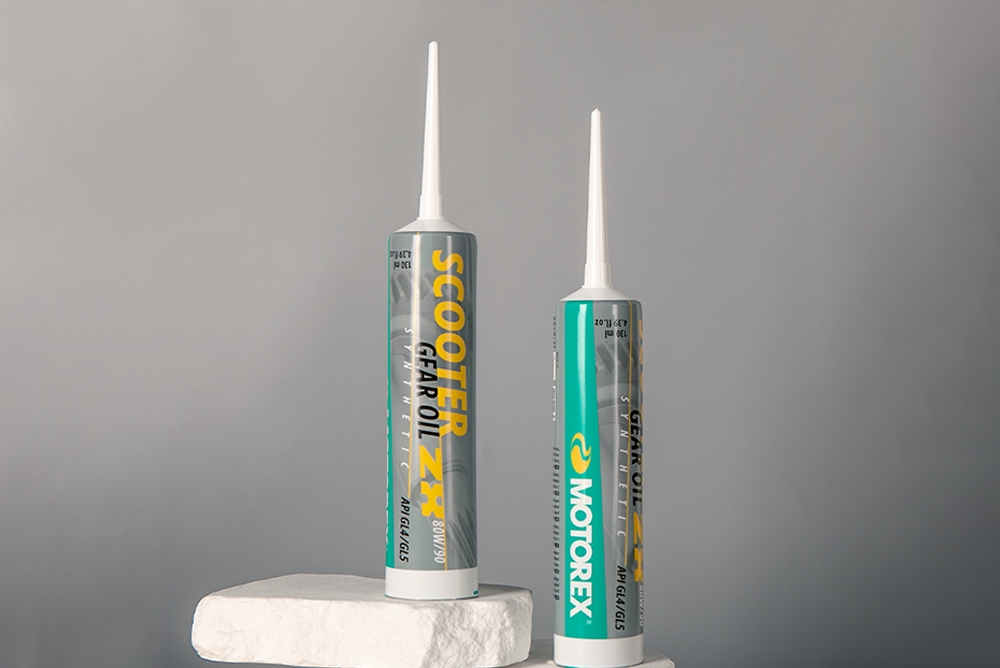
After reviewing the formula’s chemical data sheet, the brand’s dispensing use-case, and their retail channel requirements, our team proposed a custom HDPE pointed nozzle squeeze tube in 100ml capacity — with a specific material specification, orifice geometry, and decoration brief built around the automotive context.
Why a Pointed Nozzle Tube for Motor Oil Application
The pointed nozzle tip tube — sometimes called a needle-nose tube or applicator nozzle tube — is a squeeze tube format where the shoulder tapers to a narrow, elongated tip rather than a standard flat-crimped or screw-cap opening. The tip diameter and length can be precisely engineered to the dispensing requirement.
For this application, we specified a 2mm orifice diameter on a 40mm tapered nozzle tip. This geometry allows the tube to be inserted directly into a standard engine oil fill port and depressed at a controlled rate — the user squeezes the body, and the viscous additive flows in a controlled stream precisely where it needs to go. No funnel. No spillage. No secondary tool. The pointed format transforms the packaging from a container into an applicator.
The nozzle tip was sealed with a twist-off breakaway cap — a molded screw tip that the user removes before first use and discards, exposing the nozzle. This is preferable to a removable cap in an automotive context: caps get lost in engine bays, dropped into engine compartments, or simply forgotten. The twist-off eliminates that failure point entirely.
Material Specification: Why HDPE Over LDPE for This Application
This is where the engineering gets specific — and where the right material decision protects both the product and the brand.
Standard cosmetic squeeze tubes are typically made from LDPE (Low-Density Polyethylene) — a soft, highly flexible material that’s ideal for hand creams and gels. LDPE offers good flexibility and squeezability, but it has a known vulnerability: it swells and softens when in sustained contact with hydrocarbon oils and ester-based lubricants. For a product sitting on a retail shelf for 12–18 months — or in a mechanic’s workshop storage — that’s a real failure risk.
HDPE (High-Density Polyethylene) offers significantly superior resistance to hydrocarbon chemistry. Its higher crystallinity means fewer pathways for oil molecules to permeate through the wall, and its molecular structure is more resistant to ester solvation. In practice, this means the tube maintains its geometry, wall integrity, and seal performance throughout its shelf life — even in contact with aggressive synthetic lubricant chemistry.
The trade-off is squeezability: HDPE is stiffer than LDPE. For a high-iscosity lubricant additive, this is actually an advantage — it gives the user more control over dispensing rate. A very soft tube with a viscous product tends to either resist squeezing entirely or deliver the product in sudden, uncontrolled bursts. The firmer HDPE wall, combined with the 3mm orifice, gives a smooth, metered flow that mechanics and car enthusiasts can actually control.
Wall thickness was set at 1.4mm — heavier than standard cosmetic tube walls — to support the firmness profile and provide additional puncture resistance for workshop environments where tubes get thrown into tool boxes and sat on.
Orifice Engineering: Getting the Flow Rate Right
One detail that’s easy to overlook — and expensive to get wrong — is the relationship between orifice diameter and product viscosity. Motor oil additives typically fall in the 500–3,000 cP viscosity range (centipoise) at room temperature, but become significantly more viscous at lower workshop temperatures (below 10°C in winter climates).
We specified the 3mm orifice based on the brand’s formula viscosity data at 5°C — the worst-case dispensing condition for a European winter. At that temperature, the formula required a minimum orifice of 2.8mm to dispense without excessive force. We added 0.2mm as a margin, landing at 3mm — enough for controlled flow at cold temperatures without being so wide that the user loses precision at room temperature.
This kind of orifice-to-viscosity calculation matters enormously in practice. A nozzle that’s too narrow makes the product unusable in cold weather. A nozzle that’s too wide makes precision dispensing impossible. Getting it right is the difference between a product that users love and one they return.
Visual Design for Automotive Retail
The brand’s existing visual identity was built around a charcoal grey, matte black, and electric yellow palette — deliberately industrial and technical. We executed the tube decoration in three-color offset printing directly on the tube body, with:
- Matte black base coat on the tube body — providing a premium, tactical aesthetic distinct from the glossy cosmetic tubes nearby
- Electric yellow band and logo in the brand’s exact Pantone specification
- Technical spec callouts printed in white: viscosity grade, compatible engine types, and application volume — the information a mechanic needs to see at a glance before reaching for the product
- A debossed “APPLY DIRECTLY” instruction band near the nozzle tip — a small functional detail that reduces first-use errors and returns
The pointed nozzle itself was molded in translucent natural HDPE — deliberately contrasting with the opaque black body — so users could visually confirm the product was flowing during application. This was a functional design decision, not a cosmetic one.
Production & Timeline
| Milestone | Timeline |
|---|---|
| Formula data sheet review & material specification | Day 1–3 |
| Orifice geometry calculation & nozzle tooling brief | Day 4–5 |
| 3D rendering & brand artwork integration | Day 6–8 |
| Pre-production sample with printed decoration | Day 16 |
| Cold-temperature flow test by client (passed at 5°C) | Day 18 |
| Client approval — no revisions required | Day 19 |
| Mass production: 30,000 units @ 100ml | Day 20–32 |
| QC inspection: wall integrity, seal, orifice diameter | Day 33–34 |
| Shipment to German distribution warehouse | Day 35 |
Results
- Zero packaging failures reported across the first 10,000-unit run — no tube swelling, no seal failure, no orifice clogging
- Cold-temperature dispensing performance validated by the brand’s in-house QC team at 4°C — formula dispensed smoothly without excessive force
- The product received placement in three EU automotive retail chains within 90 days of launch — retail buyers cited packaging format as a key listing factor (“it’s clear what it does and how to use it”)
- One automotive enthusiast forum thread titled “Finally, a tube you can actually use in an engine bay” generated 340 replies and was cited by the brand’s marketing team as organic proof-of-concept for the packaging redesign
Ready to Engineer a Custom Nozzle Tube for Your Product?
Sunripack manufactures custom pointed nozzle squeeze tubes from 20ml to 250ml in LDPE, HDPE, and multi-layer barrier constructions. We work with clients across cosmetics, pharmaceuticals, adhesives, lubricants, and specialty chemicals — wherever precise, controlled dispensing matters.
Decoration options include offset printing, silk-screen, hot stamping, and matte or gloss surface finishes. Nozzle tip geometry, orifice diameter, and cap style (twist-off, screw cap, or snap cap) are fully customizable to your application.
MOQ from 10,000 pcs. Technical consultation and material compatibility review available before tooling commitment.